


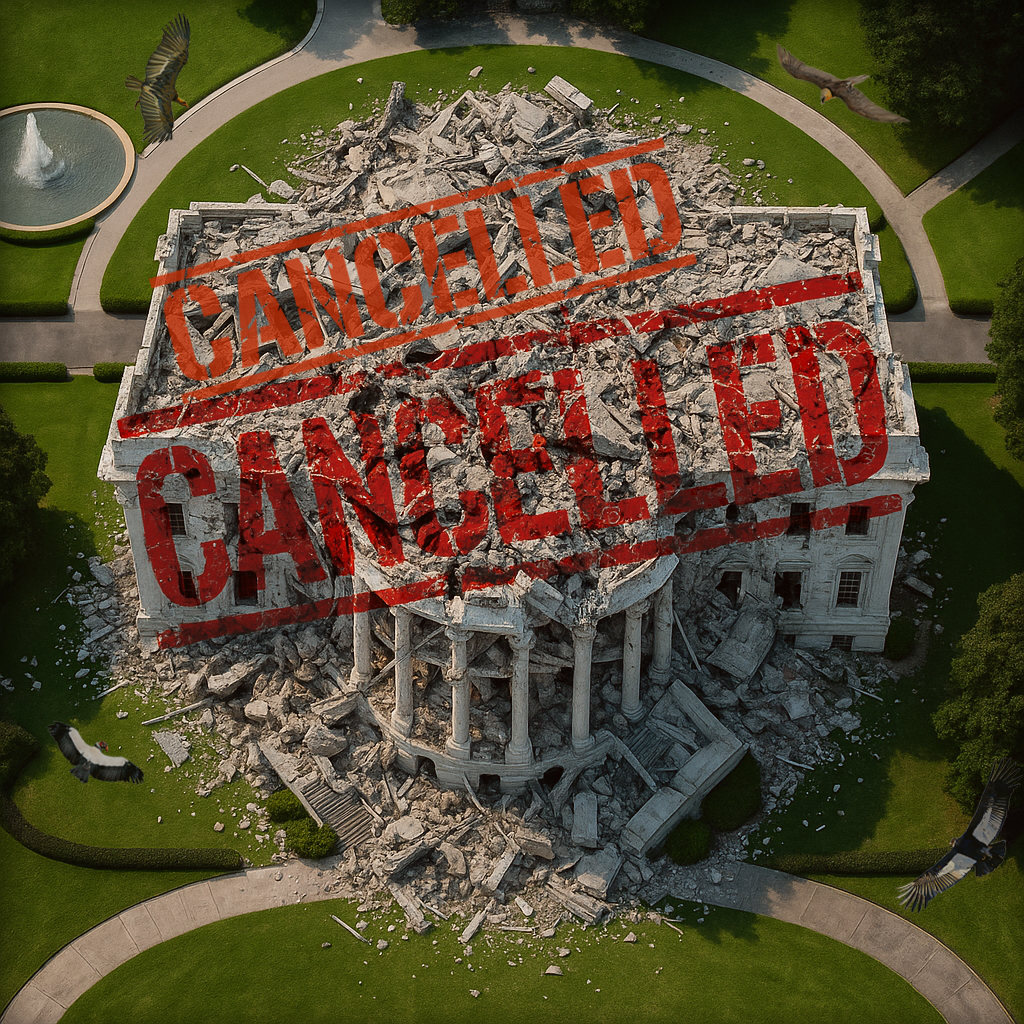
The Truth About Cancel Culture
 By Frank F Islam & Ed Crego, December 4, 2025 (Image credits: Tom de Boor, JNCGPT51)
Over the past decade or so, the term “cancel culture,” and its traveling companion “woke,” have been used by some on the right to label and vilify those on the left who have spoken out and taken actions contrary to their perspective.
Media coverage has disclosed that there are some on the right who employ cancel culture tactics. Truth be told, they are much better practitioners of the cancel culture than those on the left.
We made this point in a 2021 blog titled, “Do We Have Woke and Cancel Culture Backwards,” in which we asserted:
The more existential threats are presented not by the left but by those in the Trumpist cancel culture who, through their actions and voices, have indicated that they would cancel, to name just a few, and not even go into the cancellation of the U.S.’s role in world leadership: the federal government; science; medicine; voters rights; immigration; the news media and free press; the truth; and democracy.
We then provided examples of woke speech and cancel culture initiatives in those areas generated by then President Donald Trump and his MAGA supporters. In his return to office for his second term, Trump has taken his woke speech and cancel culture actions to deeper and darker levels. On November 26, Reuters issued a special report documenting that “at least 470 people, organizations, and institutions have been targeted for retribution since Trump took office…”
People Trump added to his hit list recently were Representative Marjorie Taylor Greene, who had become a leader in calling for the release of the Epstein files, and six Democratic congresspeople with backgrounds in the military and intelligence, who made a video advising those in the military to refuse illegal orders.
Trump’s response to Greene was to label her Marjorie “Traitor” Greene and withdraw his endorsement for her re-election to Congress. Greene, who had been one of Trump’s strongest allies in Congress, responded to Trump by announcing she was resigning from Congress effective January 5, 2026, and issued a video and statement, which included her saying that she would not be treated like “a battered wife, hoping it all goes away and gets better.”
Trump’s response to the six Democratic lawmakers was to post on Truth Social that they were engaged in “seditious behavior at the highest level.” And that each one of said traitors should be arrested and put on trial. He later added that their behavior should be “punishable by death.” Following this, he shared a post from someone else declaring, “Hang them George Washington would!!”
These are just a few of Trump’s recent calls for cancellation. In mid-October, as Glenn Thrush of the New York Times reports, with his Attorney General Pam Bondi, her deputy Todd Blanche, and FBI Director Kash Patel standing behind him in the Oval Office, Trump assumed the role of prosecutor-in-charge. He called for the prosecution of Jack Smith, who brought two criminal indictments against him, Andrew Weissmann, a former FBI official who led the investigation of the Trump campaign’s ties to Russia during the 2016 elections, and Lisa Monaco, the deputy attorney general during the Biden administration.
Trump, in his usual woke fashion, denigrated those three individuals, stating, “Deranged Jack Smith is a criminal,” “Weissman is a bad guy,” and “…Lisa who was his puppet worked in his office as the top person.”
It might be assumed that Trump is the person responsible for right-wingers engaging in, and becoming the leaders of, cancel culture. Historian Dr. Nicole Hemmer, in her informative New York Times article, explains that is not the case stating “..the modern right in America emerged as a censorious movement. It took decades for its free-speech faction to develop, and even then, it has only ever been a minority part of the coalition.”
Hemmer traces the emergence of cancel culture on the right back to the Cold War, and provides examples of its utilization by the Republican right wing coming forward to today. Of the Cold War she notes, “The conservative movement that arose at the start of the Cold War readily married government power and private efforts to crack down on its political opponents.” She cites the well-known utilization of this approach by Senator Joseph McCarthy to go after his dubious list of communists, adding that “Leaders in higher education, film, broadcasting, and government used mass firings, loyalty oaths, and censorship to purge both supposed and actual leftists from their institutions over the next several years…”
Hemmer provides several other examples of right-wing cancellation through the years, including the 1990’s when culture-wars politics led to campaigns against museum exhibits, rap music, federal funding for the arts, and others; the period after 9/11 when there was pushback against those who were deemed too extreme in their views, like Bill Maher and his show Politically Incorrect, leading to its cancellation; and recently, the attacks on libraries by book banning groups like Moms for Liberty.
Near the end of her piece, Hemmer observes:
Long before concerns surfaced about the “woke right,” long before the campaigns to cancel Mr. Kirk’s critics, it was clear that the right’s vision of power involved sharp limits on its opponents and on their free expression.
It is the “campaigns to cancel Mr. Kirk’s critics,” though, that captured media and public attention in October.
Jeremy Peters of the New York Times, in commenting on what was going on at that time, wrote:
The term “woke right” had been circulating in online political commentary for months before Mr. Kirk’s assassination. It suggests — in terms that most conservatives find repellent — a legal and rhetorical framework that mirrors the unforgiving tactics that critics say the left used to make academic theories about social justice mainstream.
And Anne Branigan of the Washington Post astutely wrote:
On one side are those who say being fired for an offensive social media post is simply “consequence culture”; on the other, those who worry about falling down the slippery slope of censorship.
These are familiar fault lines, paths well-trodden since online shaming became a cultural flash point. And they highlight cancel culture’s central truth: It tends to be cancel culture when your enemies, or perceived enemies, do it. When your team does it, it’s justice.
The “consequence culture” argument was trotted out by some conservatives to try to justify actions taken against those who ‘deserved it,’ in response to their perceived negative words or behaviors. They contended those consequences were not part of the cancel culture. That positioning was specious.
Truth Or Consequences was a long-running TV game show in which contestants would have to perform a stunt if they did not answer a quiz question correctly. There is no truth in the consequence culture label. Those who use it, however, will not have to perform a stunt.
The price they will pay is that everyone will see that cancel culture in the U.S. abounds. It is not an un-American left-wing thing. It is an American thing.
More importantly, with the ascendancy of Donald Trump and his MAGA allies and supporters, cancel culture has become a primary tool of the right wing for crippling free speech, as well as other individual and organizational freedoms. During Trump’s second term, the federal government is being used as a cudgel to attack and decimate those on the opposite side.
This democratic republic, and those citizens who believe in the Bill of Rights and the American Constitution, will pay the price if this situation is not reversed. As he left the constitutional convention in 1787, Benjamin Franklin was asked what type of government had been established. Franklin responded, “A republic, if you can keep it.”
Through thick and thin times, we Americans have managed to “keep it” for nearly 250 years. In 2025, that republic may be more at risk than it has ever been since it was established.
Cancel culture is not a positive contributor to our way of life, no matter who deploys it. When it becomes an executive tool for unbridled retaliation, revenge, and retribution, it can be deadly.
James Madison, one of our nation’s founding fathers, understood this. In Federalist 47, he warned that:
The accumulation of all powers, Legislative, Executive, and Judiciary, in the same hands, whether of one, a few, or many, and whether hereditary, self-appointed, or elective, may justly be pronounced the very definition of tyranny.
And at the constitutional convention in Philadelphia, he stated:
A standing military force, with an overgrown Executive, will not long be safe companions to liberty. The means of defence against foreign danger have been always the instruments of tyranny at home.
Madison wrote those cautionary words in 1787 and 1788. Today in 2025, we are living through the governmental tyranny he predicted. The question yet to be answered is: can our democracy survive this tyranny. Or will it be cancelled?