


AI: Who Will Win this American Revolution?
 By Frank F Islam & Ed Crego, May 7th, 2026 (Image credits: Tom de Boor, JNCGPT52)
In 2026, the United States of America is in the middle of an AI (artificial intelligence) revolution. This revolution could be as consequential for the future of this nation and its citizens as the American Revolution, which began in 1776.
The revolution of 1776 was fought to determine whether the people or a king would rule over this country going forward. This revolution, 250 years later, will determine whether the people or AI will rule this country in the future.
That may seem like an overstatement. We don’t believe it is because concerns regarding the potentially devastating impact of AI have been raised by experts such as Geoffrey Hinton, known as the “Godfather of AI,” who won the 2024 Nobel Prize in physics for his AI work on neural networks, and Eric Schmidt, the former CEO and executive chairman of Google.
In a Time Magazine essay, Hinton wrote:
My sense is unless we act quickly, the huge increases in productivity that AI will surely bring could be accompanied by some very negative side-effects. It will likely replace most jobs that involve mundane, intellectual labor. This will lead to greater inequality which will provide a breeding ground for violent populists. Bad actors will use AI for biological warfare, and corrupting elections with fake videos.
Hinton went on to observe:
Most experts believe that some time within the next 20 years, AI will become much smarter than humans at almost everything, including persuasion. Nobody knows how humans can stay in control. We have already seen AI use blackmail to prevent itself being replaced. We won’t be able to turn it off because it will persuade us not to.
Eric Schmidt concludes his piece on 5 key developments in AI, published by the New York Times, by writing:
Managing A.I. development is a civilizational challenge… Aligning A.I. to human values and ensuring it optimizes for our interests forces us to reckon with political and philosophical questions we’ve never encountered at this scale, such as these: What constitutes human flourishing? Whose conception of the good should prevail? How do we preserve human agency in a world where machines make decisions affecting billions? Increasing A.I. alignment is as critical as increasing A.I. capability. We need to build a future where humans retain a say over the norms that govern humanity’s most powerful invention.
What has Hinton, Schmidt, and other knowledgeable individuals worried is the emergence of artificial general intelligence (AGI), much more rapidly than expected.
In an IBM publication, Dave Bergman and Cole Stryker define AGI as: “a hypothetical stage in the development of a machine learning in which an artificial intelligence system (AI) system can match or exceed the cognitive abilities across any task.” In 2026, that “hypothetical stage” is becoming less and less hypothetical and more and more inevitable and factual.
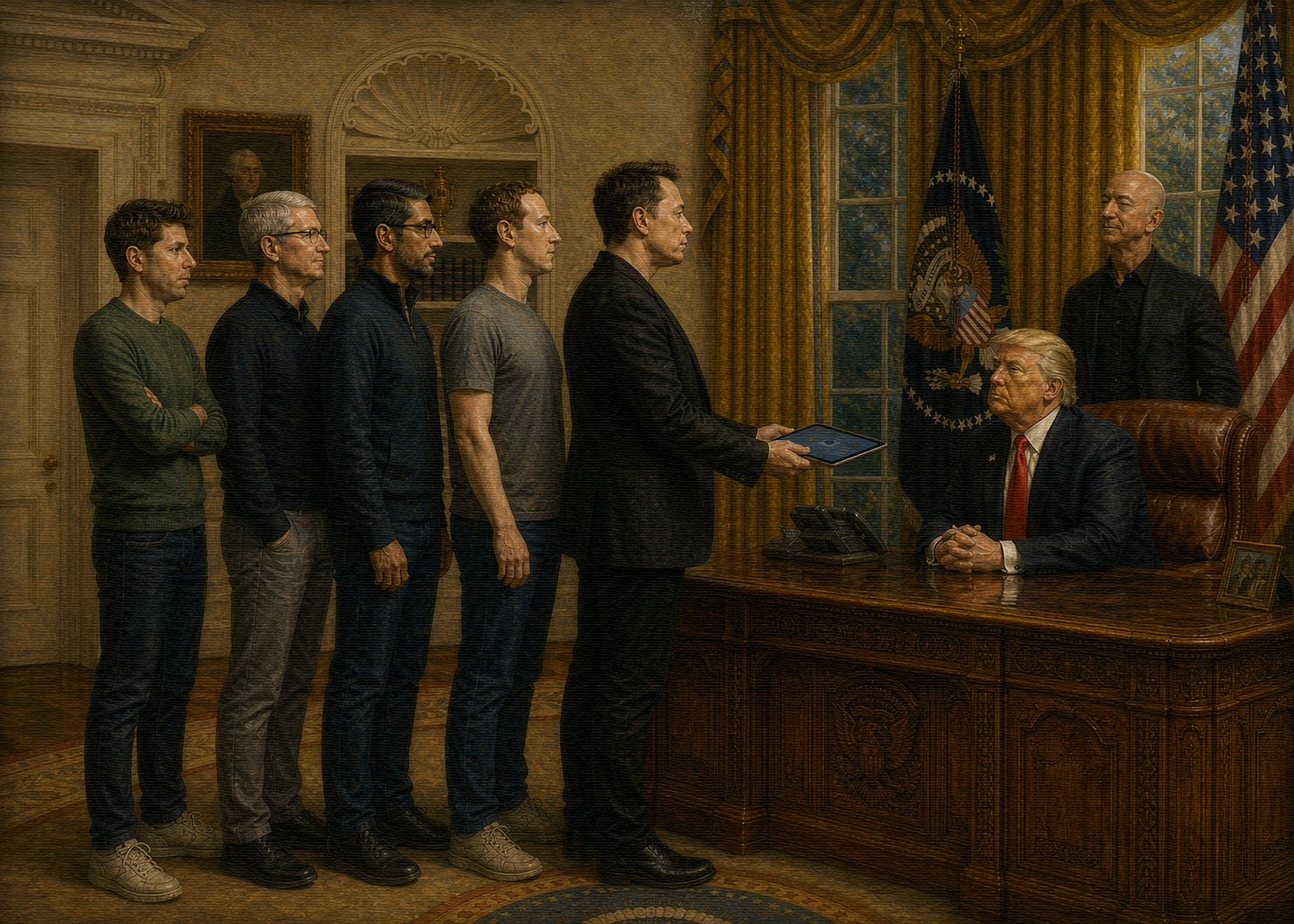
There are many reasons for this. Two primary ones are (1) The competition between the tech giants to win the AGI race in order to secure the largest market share and maximize profitability. (2) The Trump administration’s positioning of AI as of pivotal importance to the future of the United States.
Trump has issued executive orders, and the administration has prepared an AI Action Plan centered on three pillars: accelerating innovation, building AI infrastructure, and leading in international diplomacy and security. The introduction to the Action Plan states it is “America’s roadmap to win the race.”
Tom Wheeler, Visiting Fellow at the Brookings Institution and former Director of the FCC, analyzes those orders and the Action Plan in a Brookings commentary. The synopsis of his commentary states “The new policy presents itself as promoting AI innovation and development leading to international leadership, principally by allowing the AI firms to make their own rulebook.”
And that rulebook will have few rules because of the Executive Order titled “Ensuring a National Policy Framework for Artificial Intelligence” that Trump issued on December 11, 2025. That Executive Order makes it clear the AI companies are in charge, and essentially can do what they want, without much interference from the federal or state governments.
It begins by stating that via an earlier EO, “I revoked my predecessor’s attempt to paralyze this industry and directed my administration to remove barriers to United States AI leadership.” It goes on to emphasize, “To win, United States AI companies must be free to innovate without cumbersome regulation. But excessive State regulation thwarts this imperative.”
After that, it explains why state-by-state regulation is not good and a national policy is necessary, and proclaims “It is the policy of the United States to sustain and enhance the United States’ global dominance through a national policy framework for AI.”
The bulk of the Order is devoted to the steps to be taken to constrain or eliminate “excessive” or unnecessary state laws and replace them with a national policy. These steps are;
- Establishing an AI Litigation Task Force
- Evaluation of State AI Laws
- Restrictions on State Funding
- Federal Reporting and Disclosure Standard
- Preemption of State Laws Mandating Deceptive Conduct in AI Models
It then declares “The Special Advisor for AI and Crypto and the Assistant to the President for Science and Technology shall jointly prepare a legislative recommendation establishing a uniform Federal policy framework for AI that preempts State AI laws that conflict with the policy set forth in this order.”
The Special Advisor for AI and Crypto was David Sacks, a Silicon Valley venture capitalist with substantial investments in AI. Sacks has now stepped down from that position because he has “used up” the 130 days allowed to be a Special Government Employee.
The Assistant to the President for Science and Technology is Michael Kratsios. Kratsios served as Chief Technology Officer of the White House during the first Trump administration. According to his bio, he was the architect of the nation’s first AI strategy, the American AI Initiative, which doubled federal AI and quantum research spending. His bio also states that “Prior to the White House, Michael invested in, advised, and built technology companies in Silicon Valley.”
Given their backgrounds, it was highly unlikely that these two consultants to the President would craft policy that places many, if any, constraints on AI, AGI, or its practitioners. And they did not.
On March 20, the White House released a “National Policy Framework for Artificial Intelligence.” That Framework has seven sections.
The first four sections listed below appear to be somewhat protective, but put no meaningful constraints on AI producers:
I. Protecting Children and Empowering Parents
II. Safeguarding and Strengthening American Communities’
III. Respecting Intellectual Property Rights and Supporting Creators
IV. Preventing Censoring and Protecting Free Speech
The last three sections aid and abet the virtually unconstrained efforts of AI companies:
V. Enabling Innovation and Ensuring American AI Dominance
VI. Educating Americans and Developing an AI-Ready Workforce
VII. Establishing a Federal Policy Framework Preempting Cumbersome State AI Laws
This National Policy Framework was not written by AI companies, but it is definitely written for them. It is devoid of any specific recommendations to regulate AI firms.
Tom Wheeler and Bill Baer, former assistant attorney general of the antitrust division in the U.S. Department of Justice, in a Brookings Commentary, state:
Having sidelined Congress in seemingly everything else, the administration now delegates AI policy to the legislative branch, offering a series of “Congress should” bromides. At the same time, the policy is devoid of any meaningful discussion of the responsibility and accountability of those whose decisions created the very issues it seeks to address.
The plan mistakes symptoms for causes.
This is extremely problematic because, as Eric Schmidt advised, “Managing AI development is a civilizational challenge.” And as Geoffrey Hinton cautioned, “Nobody knows how humans can stay in control.”
In 2026, we are fast approaching the precipice where AGI could supplant human intelligence and make the rules for us rather than us making the rules for it. The failure to recognize and to take the necessary actions to ensure that “authentic intelligence” prevails over AI and AGI would result in democratic doomsday scenario.
We will examine the necessary scope and nature of the actions that need to be taken to avoid that scenario and to ensure a victory for authentic intelligence in our next blog — which will not be written with the assistance of nor by AI.