How Many Branches?
 By Frank F Islam & Ed Crego, October 13, 2026 (Image credits: Tom de Boor/JNCGPT56)
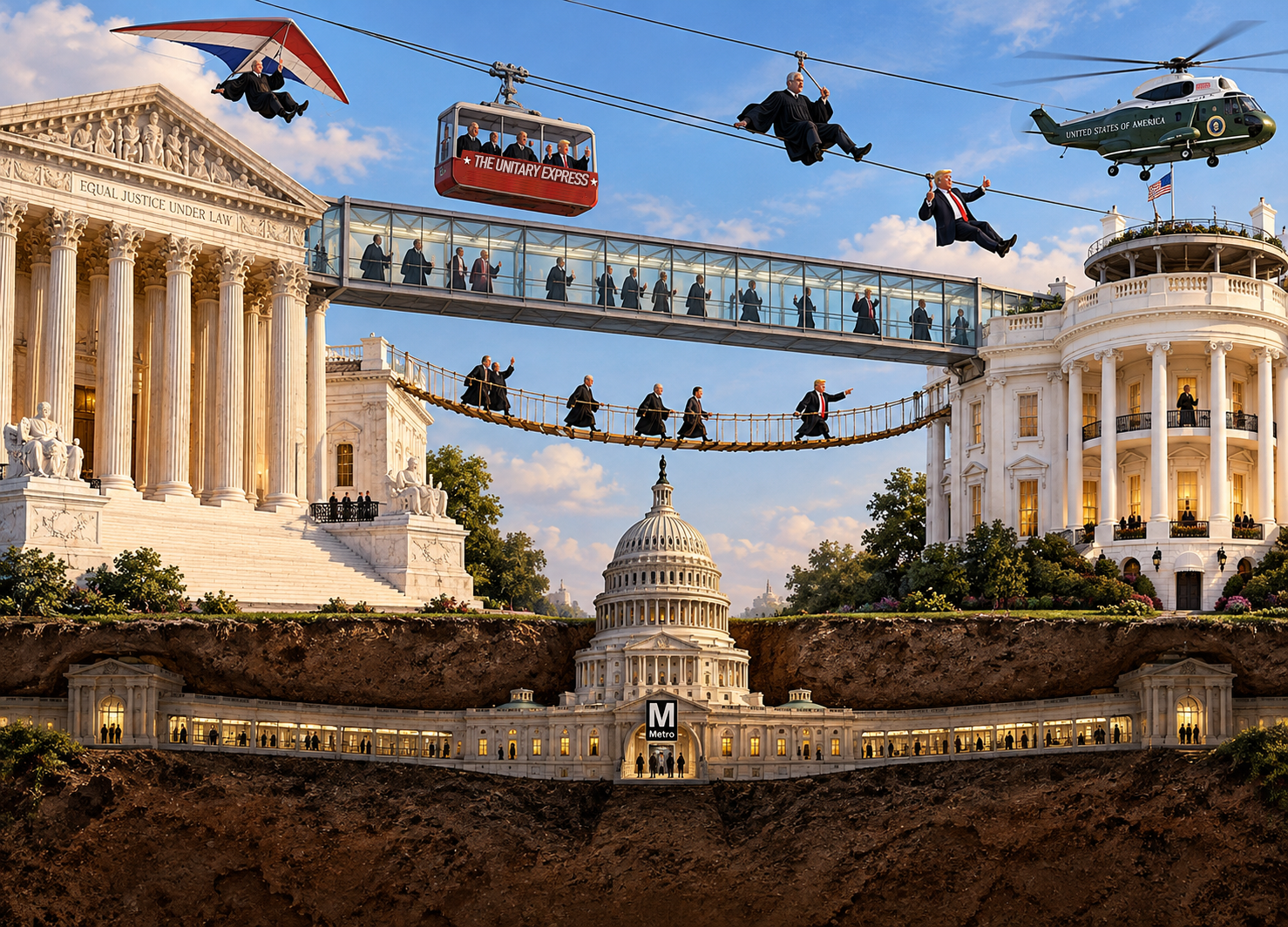
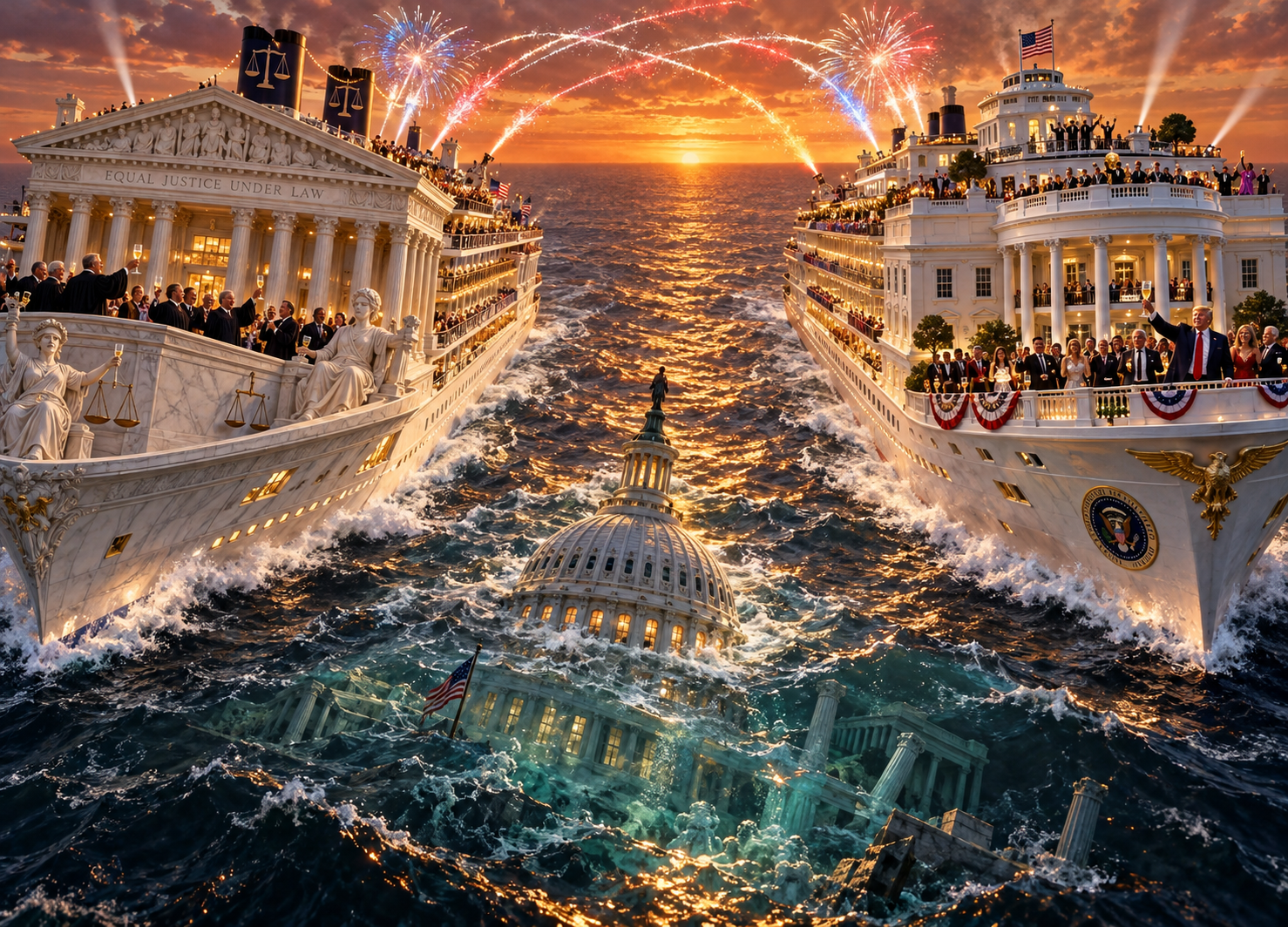
The Constitution establishes three separate branches of government — legislative, executive, and judicial. In 2026, those branches still exist but not in the manner intended nor envisioned by our nation’s founders.
The Constitution spells out the primary responsibilities of those branches in Articles I, II and III. Article I is for the legislative branch and has ten sections. The founders put the legislative branch first because they wanted it to be more influential than the executive branch. Article II is for the executive branch and has four sections. Article III is for the judicial branch and has three sections.
The three branches were established to ensure a separation of power: the legislative branch makes the law; the executive enforces the law; and the judicial interprets the law. The powers granted or not granted to each branch are described in part in the following paragraphs.
Section 8 of Article I begins stating,” “The Congress shall have Power to lay and Collect Taxes, Duties, Impost and Excises; to pay the Debts and provide for the common Defence and general Welfare of the United States.”
Powers it gives to Congress Include:
- To declare War
- To raise and support Armies
- To provide and maintain a Navy
Section 8 concludes by stating, “To make all Laws which shall be necessary and proper for carrying into execution the foregoing Powers, and all other Powers vested by this Constitution in the Government of the United States, or in any Department of Officer thereof.”
Article II states that “The executive Power shall be vested in a President of the United States of America.” The most important power it names is that “The President shall be Commander in Chief of the Army and Navy of the United States, and of the Militia of the several States, when called into the actual Service of the United States…”
Importantly, Article II states
Before he enters on the Execution of his Office, he shall take the following Oath or Affirmation — “I do solemnly swear (or affirm) that I will faithfully execute the Office of President of the United States, and will to the best of my Ability, preserve, protect and defend the Constitution of the United States.”
Given Trump’s time in office as the president, it is also important what a president cannot do. The Harry S. Truman Library and Museum (honoring the man who said “the buck stops here”) reports that:
A PRESIDENT CANNOT . . .
- make laws.
- declare war.
- decide how federal money will be spent.
- interpret laws.
- choose Cabinet members or Supreme Court Justices without Senate approval.
Article III on the judicial branch provides minimal information on the role of the branch. It begins by stating, “ The judicial Power of the United States, shall be vested in one supreme Court, and in such inferior Courts as the Congress may from time to time ordain and establish.” It goes on from there to enumerate the types of cases the judicial branch should hear.
It has been stated that the judicial branch was an afterthought of the founders. This has been debated through the years.
What can be said unequivocally is that the courts were not a primary thought of the founders. Their role was simply, as Alexander Hamilton wrote in Federalist №78:
“to be an intermediate body between the people and the legislature, in order to keep the latter within the limits assigned to their authority.”
With some of its rulings over the past few years, the Supreme Court is no longer an intermediate body, but a body which makes rules and, through its application of the unitary executive theory, has elevated the current president above the legislative body in terms of his ability to exercise powers not granted to him in the Constitution.
Consider Trump’s actions listed in the following table:
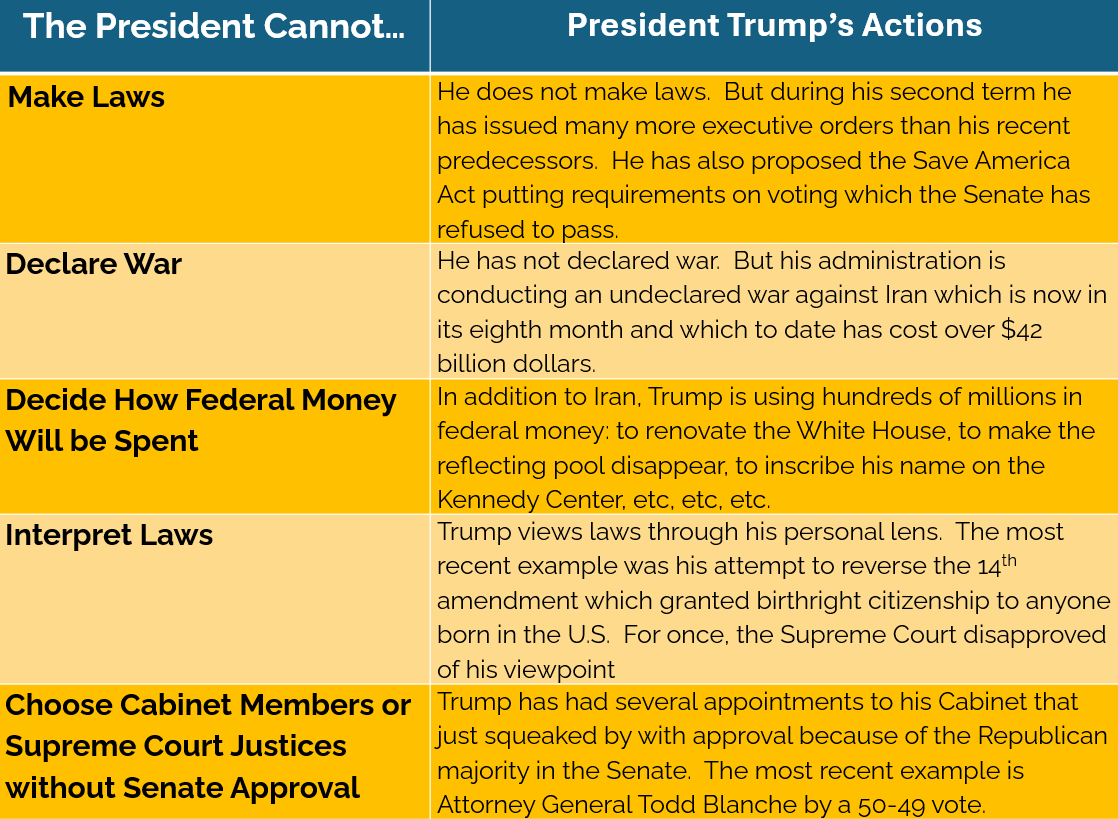
In 2026, the Articles of the Constitution have been inverted. The legislative branch is no longer at the top. The executive branch in conjunction with the judicial branch and the Supreme Court as its partner are first and second and the legislative branch is third.
With its ruling in Trump v. Slaughter this year, giving the President unbridled authority to fire the commissioners of once “independent agencies,” as Cass Sunstein writes, at the beginning of his guest essay for the New York Times, “…the unitary executive is now the law of the land.”
In conclusion, as we noted in our blog preceding this one, “Donald Trump has made the U.S. Congress virtually irrelevant.” And in a blog posted toward the end of last year,
In the Congress controlled by the Trump administration and the Supreme Court collaborating with the Trump administration, it may not be an overstatement to say there may no longer be three equal branches of government. Today, there may only be one branch. It might be labeled the unified branch of the Supreme Rulers.
Our democracy was created with a balance of power in three separate branches to ensure there would be no kings and we the people would rule. In a country where there are three separate branches in name only, and the majority of power has been transferred to the President, there may still be no kings per se. But, if this is not changed at some time in the near future, there will be no democracy either.