


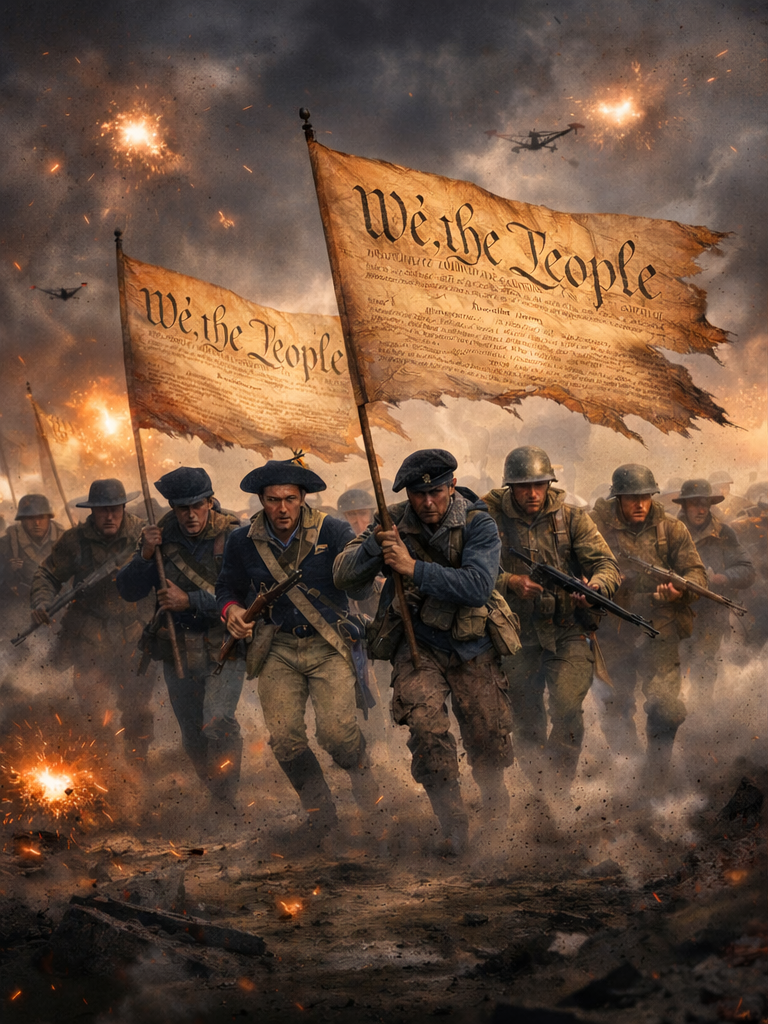
At War with the Constitution
 By Frank F Islam & Ed Crego, April 9th, 2026 (Image credits: Tom de Boor, JNCGPT52)
After Donald Trump and his “Department of War” launched the war with Iran, there were comments by Republicans that it is really not a war but a conflict because Congress did not officially declare the Iranian intervention a war.
Those Republicans would undoubtedly say the same thing about Trump’s war on the U.S. Constitution. No matter what you call it, Trump’s attacks on and avoidance of the Constitution and the laws of this land during his second terms puts the future of our democratic republic at risk.
Thomas Edsall advances a similar perspective regarding Trump’s continuous over-reach as President. Edsall notes in his March 10 New York Times column, “So far, the war on Iran falls into a larger pattern of Trump policies leaving wanton destruction in their wake.”
Gary Jacobson, a political scientist at the University of California-San Diego, is quoted in Edsall’s column as stating:
… [Trump] is not constrained by respect for any rule or institution that does not serve his interests and so pushes for as much as he can get away with — norms, laws, the Constitution and basic human decency be damned. He doesn’t care about the consequences except insofar as they threaten his self-image as a strong winner.
“Act now, think later, and try to get away with what you can in the interim” is an apt summary of his approach to governing.
Brendan Nyhan, a political scientist at Dartmouth observes:
Judges appointed by presidents in both parties are doing heroic work at the case level in trying to uphold the law, but the system is not built to address the scope of the lawlessness that we now face.
Trump is always challenging the boundaries of his powers and authority. He has a bully’s instinct for identifying weakness and pulling back when he encounters resistance.
In a blog posted this February, we stated:
In terms of the Constitution, Trump has been equivocal in speaking about it, but unequivocal in taking actions contrary to it.
In 2017, during his first term in office, he issued a statement saying “As President, my highest duty is to defend the American people and the Constitution of the United States of America.” In 2022, after he lost the 2020 election to Joe Biden, which he falsely claimed was stolen, he posted on Truth Social: “A Massive Fraud of this type and magnitude allows for the termination of all rules, regulations, and articles, even those found in the Constitution.” In May 2025, during an interview on NBC’s Meet the Press, Kristen Welker asked him if he needed to uphold the Constitution. His response was “I don’t know.”
Trump went on to say that “I have brilliant lawyers that work for me, and they are going to obviously follow what the Supreme Court said.” That is what Trump said. But as always, what he says is not necessarily what he does.
Trump’s actions speak louder than his words. They say that the Constitution is immaterial to him. What is relevant is what he wants to do, and wants done, and to have absolute control over everything and everyone.
We concluded that blog warning:
If this democracy is to survive and to thrive, there need not be a revolutionary war, but there must be a united front to end the devolutionary war that Trump has launched, with a victory not for a unitary leader, or those who would divide us, but for we, the people working together to create a more perfect union for all.
That was February. In April, Trump’s relentless and reckless war on the Constitution and the rule of law in these United States continues unabated.
There have been hundreds of lawsuits filed against Trump’s executive orders and actions taken by his administration since his return to office. The AP News ( has been tracking the status of those suits. They cover a broad swath of areas, organizations and groups. To name just a few, they include: federal agency cuts, DEI, environment, education, and tariffs.
The latest update of that tracking, made on January 16, 2026, showed that:
- 150 had been “partially or fully blocked
- 102 had been “left in effect”
- 107 were pending
The scope and duration of Trump’s assaults has caused legal experts and political commentators to question whether Trump has created — or is on the precipice of creating — a constitutional crisis. That question has not been answered definitively.
Some commentators such as Jack Rakove, Stanford professor of history and political science, and Patrick G. Eddington, senior fellow of homeland security and civil liberties at the libertarian Cato Institute, have stated there is a constitutional crisis but it not entirely attributable to Donald Trump.
In his article for the Washington Monthly, titled “It’s Not Just a Constitutional Crisis. It’s a Constitutional Failure,” Professor Ravove points the finger at the legislative and judiciary branches for not providing the checks they are supposed to on the president’s executive orders and actions. Rakove explains that:
Once a constitutional crisis becomes an endemic condition, the term no longer usefully describes our collapsing system. Instead, we live in an era of constitutional failure when the relevant institutions cannot fulfill their responsibilities.
And ends his piece by stating:
In our fractious polity, fresh insults to constitutional norms and settled practices of governance occur. That is why the phrase constitutional crisis no longer describes our situation. The Constitution has failed, and we no longer know which institution will rescue it.
Patrick Eddington’s perspective regarding this precarious condition parallels that of Rakove’s. In his piece, Eddington observes:
If Trump does defy at-scale federal court rulings against him (which seems increasingly likely), he will have exposed the fatal flaw in the Foundersʼ constitutional design, a determined autocrat with total control over federal police and a subservient Congress can defy federal courts with impunity, a situation that, left unchecked, would mark the end of the republic and trigger the creation of an American autocracy.
His solution to this would be to amend the Constitution in three ways:
1. Amend Article II to maintain the President’ authority as commander in chief of the military, but only for foreign relations and military control, with no power to use them for domestic law enforcement.
2. Transfer the Department of Justice from the executive branch to the federal judiciary and have the Attorney General report to the courts and Congress.
3. Make it clear the President is not immune from prosecution for violating the Constitution.
Trump’s egregious executive actions have made it apparent that the Constitution definitely needs to be updated with amendments to curb the power of the presidency.
In 2022, before Trump even returned to office for his virtually unbridled second reign, three small teams of law professors — conservative, libertarian and progressive — convened by the National Constitution Center (NCC) agreed on five amendments that should be made to the constitution.
As described, by Jeffrey Rosen, then President of the NCC, and Sol Khan, of the Khan Academy, in a Washington Post article, one of those amendments:
…would allow for legislative vetoes of executive and regulatory actions. All three teams shared concerns about an imperial presidency and a runaway administrative state, typically a conservative and libertarian bugaboo. And they all found a solution in resurrecting the legislative veto, which allows Congress to negate executive actions by majority vote. Congress exercised this power from 1932 until the Supreme Court struck it down in 1983, a decision that the delegates’ amendment would overrule.
Jill LePore, Professor of History at Harvard University and Professor of Law at Harvard Law School, wrote the best-selling book We the People: A History of U.S. Constitution, published in 2025, which makes a persuasive case of the importance of and the need for amending the Constitution.
In an article for The Atlantic, based upon her book, LePore writes:
The philosophy of amendment is foundational to modern constitutionalism. It has structured American constitutional and political development for more than two centuries. It has done so in a distinctive, halting pattern of progression and regression: Constitutional change by way of formal amendment has alternated with judicial interpretation, in the form of opinions issued by the U.S. Supreme Court, as a means of constitutional revision.
This pattern has many times provided political stability, with formal amendment and judicial interpretation as the warp and weft of a sturdily woven if by now fraying and faded constitutional fabric. But the pattern, which features, at regular intervals, the perception by half the country that the Supreme Court has usurped the power of amendment, has also led to the underdevelopment of the Constitution, weakened the idea of representative government, and increased the polarization of American politics — ultimately contributing, most lately, to the rise of a political style that can only be called insurrectionary.
In her article, LePore highlights that U.S. Constitution has one of the lowest amendment rates in the world and there has been no meaningful amendment approved since 1971, which protected the citizens right to vote at the age of eighteen.
Two reasons for the limited number of amendments to the U.S. Constitution are that their ratification requires approval by two-thirds of both chambers of Congress, plus three-fourth of the states. Achieving this number in these extremely polarized times, in which Trump has not only engaged in an undeclared war on the Constitution but has manipulated the citizenry into an uncivil war against one another, is virtually impossible.
This war will make it possible, however, at some time in the future, when there is a new person sitting in the Oval Office and Congress is once again comprised of political representatives who understand that they’re there to serve the people, and not to act at the behest of a commander in chief.
Accomplishing this puts the ball back in the citizen’s court, and not the Supreme Court. As Professor Rakove opined in his “constitutional crisis” article:
Our ongoing constitutional crisis began with the presidential election last November 5. Reelecting an individual culpable for January 6 who has twice made a mockery of the presidential oath of office is itself a constitutional crisis. Nothing in his past or current behavior suggests that Trump has ever felt fidelity to his constitutional duties.
Elections matter. Whom we elect matters. They matter not only for us as individuals but for the future of our democratic republic and the U.S. constitution.
As we stated in our blog preceding this, on the Supreme Court:
The democracy that is the United States of America was not born because of the Supreme Court. It was born by and for we the people. It will be up to us to determine whether our democracy survives and thrives or becomes a memory of what used to be.